If you live in Lawrenceville, whether that's a newer build off Sugarloaf Parkway in 30045, an established neighborhood near downtown in 30046, or a subdivision tucked into the wooded lots of 30043, you already know what Georgia's climate does to the outside of a house. Pine pollen blankets everything yellow every spring. The long, humid summers let mildew take hold on north-facing walls before you even notice it starting. Oak and hardwood canopy that makes a backyard comfortable in July is also the reason the shaded side of your vinyl siding stays damp long enough for algae and mold to get a foothold. And red Georgia clay, the stuff that splashes up on your foundation during every heavy rain, doesn't rinse off with a garden hose.
Riverview Property Maintenance has been cleaning homes throughout Gwinnett County for years, and Lawrenceville properties make up a big part of our work. We see the same patterns over and over: green-black mildew striping the mortar joints on brick homes, chalky pollen buildup dulling Hardie siding, and gray-green algae spreading across stucco on homes that sit under a pine canopy. Pressure washing is the wrong tool for most of those problems. The right tool is soft washing, a low-pressure application of professional-grade cleaning solutions that kills the biological growth at the root and rinses it away without cracking mortar, lifting paint, or forcing water behind siding panels.
What Soft Washing Actually Does (and Why Pressure Matters)
Standard pressure washing uses high PSI to blast surface contamination loose. That works great on concrete driveways and brick pavers. It is not the right approach for the walls of your home. High-pressure water can drive moisture into wall cavities, strip paint from wood trim, crack stucco, and blow the granules off older painted brick. Vinyl siding can warp or crack under a direct high-pressure stream. Hardie plank can absorb water at panel joints if the pressure strips the factory finish.
Soft washing drops the pressure way down, typically under 100 PSI at the surface, and lets the cleaning chemistry do the work instead. We apply a surfactant-boosted sodium hypochlorite solution diluted to the right concentration for the surface type. It penetrates the biofilm, kills the mold, mildew, and algae cells, and breaks the bond those organisms have with your siding or brick. A low-pressure rinse carries everything away cleanly. The result lasts significantly longer than a pressure wash alone because the organism is dead, not just physically scraped to the side.
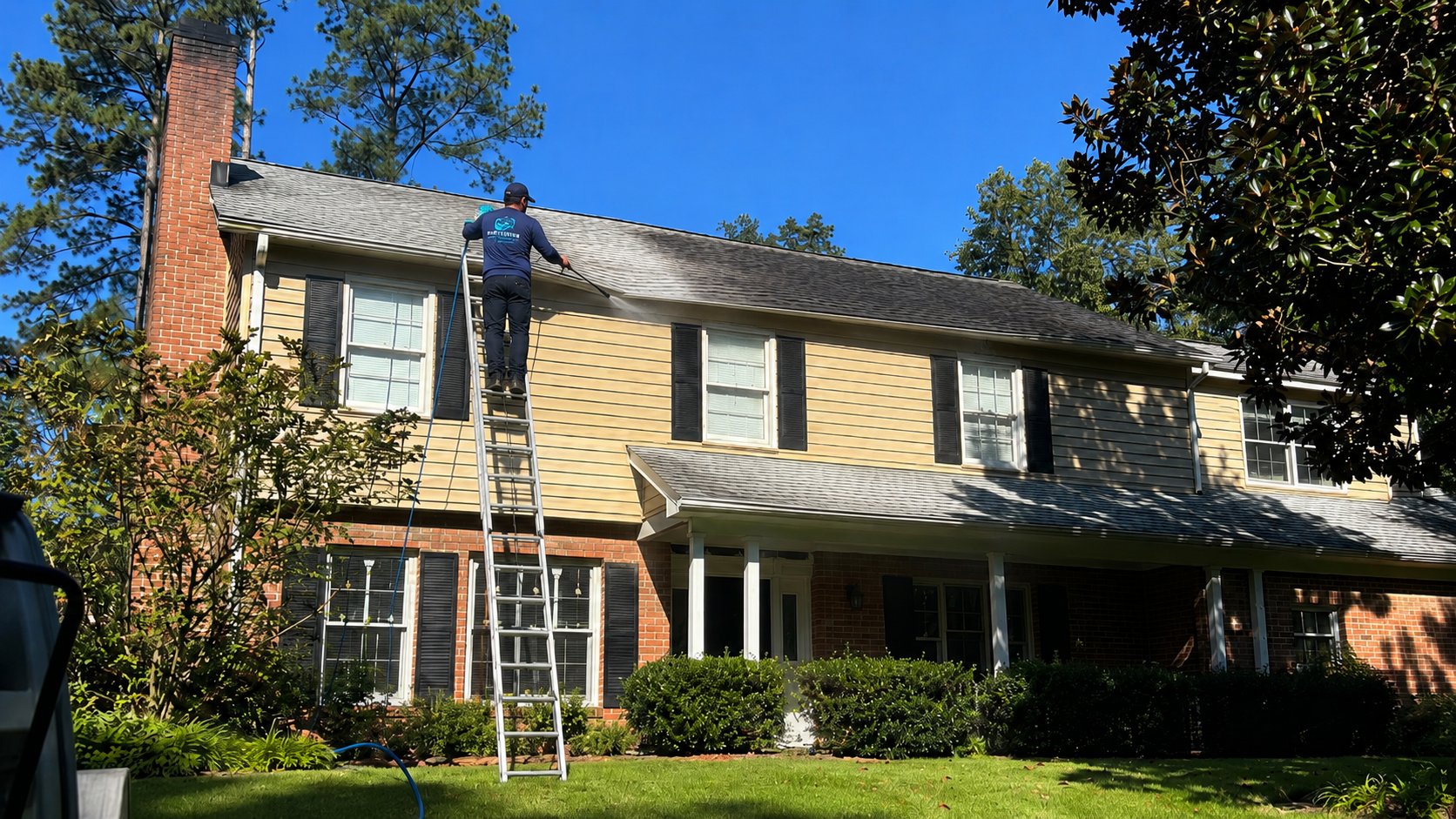
Siding Types We Soft Wash in Lawrenceville
Lawrenceville has a wide mix of housing stock, everything from 1980s and 1990s brick ranches near downtown to large two-story vinyl and Hardie-sided homes in Rivermoore Park and the Sugarloaf Country Club corridor. Each material behaves differently, and our team adjusts the mix concentration and application method accordingly.
Vinyl Siding
Vinyl is the most forgiving material to soft wash and also the one that shows pollen and algae the most clearly. A standard spring cleaning removes the yellow pine pollen film and kills any early-stage algae before it has time to stain permanently. We pay special attention to the horizontal panel laps where moisture and debris collect, and to the areas directly under roof drip edges where black roof algae runoff streaks the siding.
Brick and Mortar
Brick homes in 30046 and 30043 often have that classic north-side mildew problem, dark gray or greenish-black discoloration that looks like the brick is stained permanently. It is not permanent; it is biological growth living in the porous mortar joints. Soft washing kills it without the mortar damage that high-pressure cleaning causes. We also treat efflorescence and red clay splash-back on foundation brick, which requires a slightly different chemistry than standard biofilm removal.
Stucco and EIFS
Stucco and synthetic stucco (EIFS) are the surfaces where pressure washing causes the most damage. Even moderate pressure can crack stucco or compromise the moisture barrier on EIFS systems. Soft washing is the only responsible cleaning method for these materials, and it works extremely well because the porous texture that traps algae also absorbs the cleaning solution effectively.
Hardie Board and Fiber Cement Siding
Hardie siding is popular in the newer builds throughout 30045, subdivisions off Sugarloaf Parkway, off Old Norcross Road, and in the Rivermoore Park community. It holds up well but the factory painted finish needs to be treated gently. We use lower solution concentrations on Hardie and keep the rinse pressure minimal to protect the paint layer while still clearing all biological growth.
The Lawrenceville Soft Washing Process: What to Expect
When we show up at your property, the job follows a consistent process that protects your landscaping, your windows, and any surfaces we are not cleaning. Here is what we do on a standard house soft wash in Lawrenceville.
- Pre-rinse all plantings, shrubs, and grass beds near the foundation to dilute any overspray before we begin application.
- Cover any exposed electrical outlets, light fixtures, or vents that are at risk of direct solution contact.
- Apply the soft-wash solution to the exterior walls from the bottom up to prevent streaking, working in manageable sections.
- Allow appropriate dwell time for the chemistry to kill mold, mildew, and algae, typically 5 to 10 minutes depending on conditions.
- Low-pressure rinse from the top down, flushing all dead biological material and solution residue off the surface.
- Post-rinse all plantings and surrounding hardscapes to neutralize any residual solution.
- Inspect with the homeowner and address any spots that need a second pass before we leave.
Why Lawrenceville Homes Need This Done Regularly
Georgia's climate is not forgiving when it comes to exterior surfaces. The combination of high humidity from May through September, heavy pine pollen in March and April, and the dense tree canopy that characterizes so many Lawrenceville neighborhoods creates near-perfect conditions for rapid biological growth. Homes in Rivermoore Park that back up to wooded buffers, homes in older parts of 30046 with large oak coverage, and any property with a north-facing exposure are especially susceptible. We generally recommend a full house soft wash every 12 to 18 months for most Lawrenceville homes, with a spot treatment on problem areas, north-facing walls, areas under roof overhangs, in between full-service visits.
There is also a curb appeal and property value argument to make. Lawrenceville's real estate market moves fast, and buyers notice exterior condition immediately. A house that has been properly maintained and looks clean signals care and maintenance throughout. If you are preparing to list a home in 30045 or 30043, a professional soft wash is one of the highest-return exterior improvements you can make before photos go live.
We Cover All of Lawrenceville and the Surrounding Gwinnett County Area
Riverview Property Maintenance is based in this area and serves customers throughout Gwinnett County, including all four Lawrenceville zip codes, 30043, 30044, 30045, and 30046. We also regularly work in Dacula, Buford, Grayson, Loganville, and out into Barrow County including Winder and Auburn. If your address falls anywhere in this footprint, give us a call at (470) 968-5156. We can usually get a quote turned around quickly and schedule service within a reasonable window, even during the busy spring cleaning season.
We are not a call-center company that dispatches strangers to your home. The people who answer the phone and the people who show up to do the work are the same team. We know Lawrenceville neighborhoods, we know the specific challenges that Georgia clay, pine pollen, and humid summers create, and we bring the right equipment and the right chemistry for the job every time.
Frequently Asked Questions
Is soft washing safe for the plants and shrubs around my Lawrenceville home?
Yes, when done properly. We pre-rinse all plantings before we apply any solution and post-rinse them again when we are done. The diluted sodium hypochlorite we use is the same chemistry in household bleach, and once it is rinsed and diluted further by the rinse water it does not cause lasting harm to established landscaping. We take extra care around vegetable gardens and any newly planted beds.
How often should I have my house soft washed in Gwinnett County?
For most homes in Lawrenceville and the surrounding Gwinnett County area, every 12 to 18 months is the right frequency. Homes with heavy tree coverage, significant north-facing exposure, or a history of fast mildew regrowth may benefit from annual service. Homes in more open, sunnier locations might go closer to two years between full washes.
Will soft washing remove the black streaks running down my siding from the roof?
In most cases, yes. Those black streaks are typically caused by Gloeocapsa magma, the same algae responsible for roof discoloration. The runoff from an untreated roof carries the algae spores down onto the siding. Soft washing kills and removes the staining from the siding surface. If the streaks are coming from an actively colonized roof, we recommend pairing house soft washing with a roof soft wash treatment so the source of the problem is addressed at the same time.
Can you soft wash a home with stucco or EIFS siding?
Absolutely, and soft washing is actually the recommended method for stucco and synthetic stucco systems. High-pressure washing can crack stucco and compromise the moisture barrier on EIFS. We use low-pressure application with appropriate chemistry and a gentle rinse, which cleans the surface thoroughly without any structural risk.
Do you service neighborhoods off Sugarloaf Parkway and in Rivermoore Park?
Yes. We work throughout all the Lawrenceville zip codes, including 30043 and 30045 which cover the Sugarloaf corridor and Rivermoore Park. Those neighborhoods have a lot of Hardie and vinyl siding, and the wooded buffers behind many lots make regular soft washing a smart maintenance practice. Call us at (470) 968-5156 and we can give you a specific quote for your address.
What is the difference between soft washing and pressure washing for a house exterior?
Pressure washing uses high PSI water force to physically remove surface debris. It is effective for concrete, brick pavers, and hardscapes but can damage painted surfaces, siding, stucco, and mortar joints when applied to home exteriors. Soft washing uses very low pressure combined with professional cleaning solutions to kill mold, mildew, algae, and bacteria at the source. The result is cleaner, lasts longer, and does not carry the risk of surface or moisture damage that high-pressure cleaning does on a home's walls.