If you own a home in Buford, Georgia, whether you're in the 30518 zip code near the Mall of Georgia corridor or tucked into the 30519 neighborhoods closer to Lake Lanier, you've probably noticed dark streaks creeping down your roof. They show up on the north-facing slopes first, spread across the ridge, and make a house that's only five or ten years old look like it's been neglected for twenty. The good news is those streaks aren't permanent damage. The not-so-good news is that pressure washing will make things worse. What your roof actually needs is soft washing, and that's exactly what Riverview Property Maintenance delivers across Gwinnett County.
What Is Causing Those Black Streaks on Buford Roofs?
The streaks are caused by a cyanobacterium called Gloeocapsa magma. It travels through the air, lands on your shingles, and feeds on the limestone filler built into asphalt roofing. Georgia's humid summers and the shade cast by mature hardwoods and loblolly pines create ideal conditions for it to thrive. In neighborhoods near Lake Lanier, think Shadowbrook Cove, Lanier Woods, and the communities hugging Shadburn Ferry Road, the combination of water humidity, tree canopy, and north-facing roof planes means algae can take hold within a year of a new roof installation. Pine pollen settles into the granules every spring and gives the algae an extra food source, accelerating growth through the summer months.
Left alone, Gloeocapsa magma holds moisture against your shingles, degrading the granule layer and shortening the life of the roof. Most roofing manufacturers, including GAF and Owens Corning, will note in warranty language that algae damage from neglect is an excluded condition. Soft washing clears the algae, neutralizes the spores, and keeps the staining from returning for two to four years in most Buford-area applications.
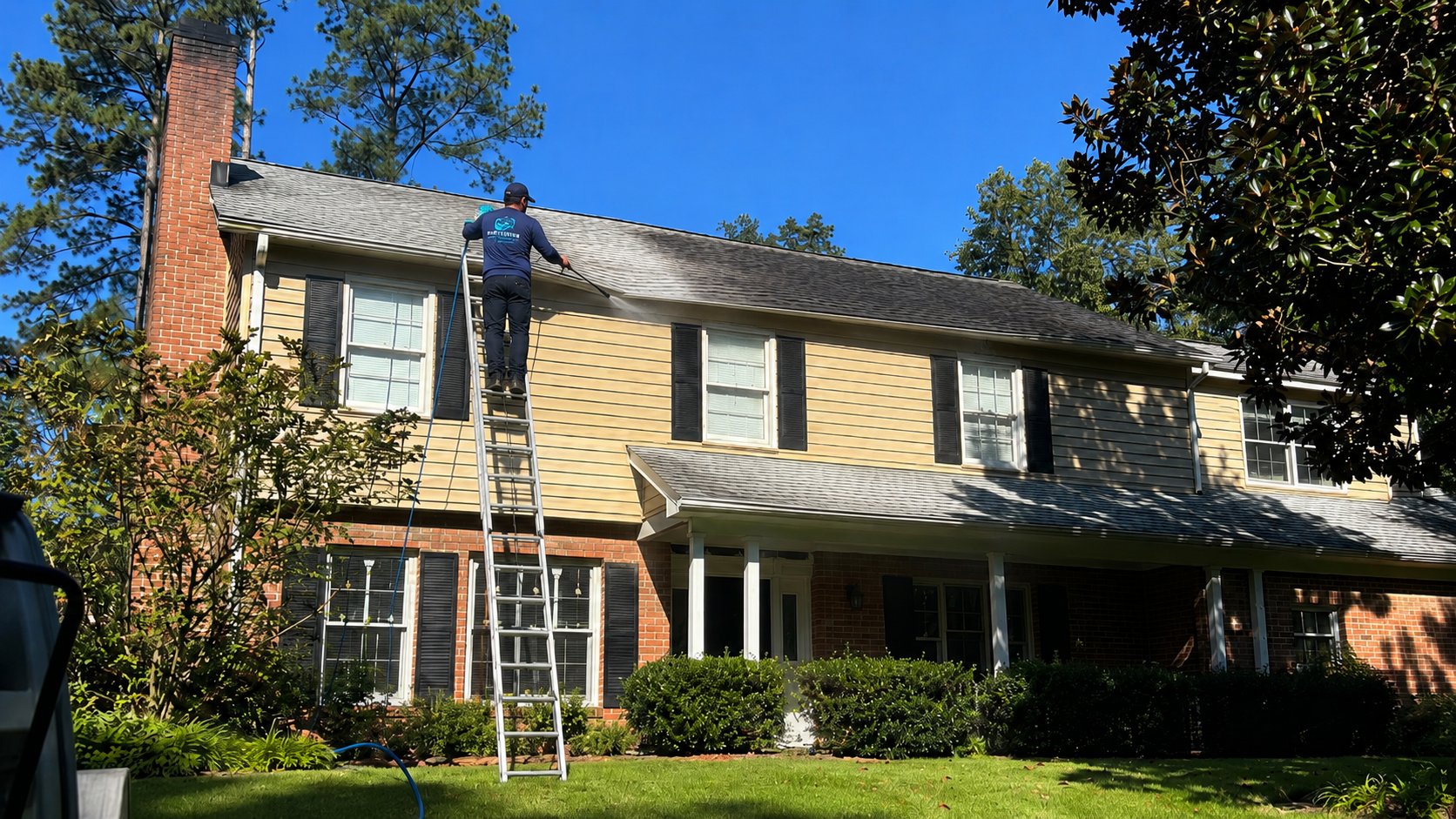
Why Soft Washing, Not Pressure Washing, Is the Right Method
A standard pressure washer running at 2,000 to 4,000 PSI will blast granules right off your shingles. Those granules are what protect the asphalt mat underneath from UV rays. Strip them off, and you've turned a cosmetic problem into a structural one. Roof soft washing uses a low-pressure delivery system, typically under 100 PSI at the nozzle, to apply a biodegradable cleaning solution formulated for asphalt, tile, and metal roofing. The solution does the work. It kills the algae, mold, mildew, and lichen on contact, breaks down the organic material, and rinses away cleanly. No scrubbing, no power blast, no voided warranty.
Riverview Property Maintenance uses an SH-based mix sized for Georgia's climate and roof type. Our tech adjusts dwell time based on the severity of the staining and the pitch of the roof. Steeper roofs common in the newer construction off Buford Drive and around the Hamilton Mill Road corridor in neighboring Dacula dry faster, so timing matters. We rinse with fresh water to remove residue and protect surrounding landscaping, gutters, and painted trim.
Buford Neighborhoods and Subdivisions We Service Regularly
We work all across Buford and the surrounding communities. If you're in any of the following areas, we can typically have a quote to you within 24 hours and schedule service within the week, depending on the season.
- Lanier Woods and Shadburn Ferry Road corridor, heavy tree canopy means faster algae growth
- Buford Highway neighborhoods near the Mall of Georgia in 30519, high-growth area with many homes 10 to 20 years old needing first-time roof treatment
- Shadowbrook Cove and communities along Shadburn Ferry, lakeside humidity accelerates staining
- Suwanee Road and Peachtree Industrial Boulevard neighborhoods in 30518
- Newer subdivisions off Hamilton Mill Road bridging Buford and Dacula
- Communities near Sugar Hill and the Gwinnett-Hall County line
If your subdivision isn't listed, call us at (470) 968-5156. We cover all of Buford, plus neighboring Dacula, Lawrenceville, Grayson, Loganville, and the Barrow County communities of Winder, Auburn, and Bethlehem. No job is too far out as long as it's in the Gwinnett or Barrow County footprint.
What a Typical Buford Roof Soft Wash Includes
Every roof soft washing job from Riverview Property Maintenance follows the same process so you know what to expect. We don't cut corners because we plan to earn repeat business from every homeowner we work with.
- Pre-inspection: we walk the roofline and note moss pockets, lifted flashing, or areas where lichen has taken hold
- Landscape protection: we wet down nearby shrubs and mulch beds before applying any cleaning solution
- Low-pressure application of biodegradable SH-based mix across the entire roof surface
- Dwell time based on staining severity, heavy organic buildup may need a second pass
- Thorough fresh-water rinse of the roof and all adjacent surfaces including gutters and downspouts
- Post-service walkthrough so you can see the results before we leave
Georgia Red Clay, Black Mold, and North-Facing Brick, The Full Picture
Gwinnett County homeowners deal with a combination of challenges that homeowners in drier climates never face. Georgia red clay splashes up onto lower roof eaves during heavy rains and stains the first few courses of shingles orange-brown at the fascia line. That clay also fouls gutters and washes across driveways and sidewalks. Black mold tends to concentrate on north-facing siding and roof planes where morning dew doesn't burn off until late morning. And the high humidity from June through September means any organic material on your roof, pine needles, oak leaf tannins, pollen, just stays wet and keeps feeding the algae.
This is why we recommend bundling roof soft washing with a house soft wash or gutter cleaning when possible. We can address the roof streaks, clear the gutters of compacted pollen and debris, and soft wash north-facing brick or Hardie siding in a single trip. It saves you a mobilization charge and gets your whole exterior cleaned at once. Ask about our combination pricing when you call (470) 968-5156.
How Often Does a Buford Home Need Roof Soft Washing?
For most homes in the 30518 and 30519 zip codes, a roof soft wash every two to three years keeps the algae from re-establishing itself. Homes under heavy hardwood canopy, especially those with multiple mature oaks providing shade over the ridge and north slope, may need attention every 18 to 24 months. Homes on open lots with good sun exposure can sometimes go four years between treatments. After we clean your roof, we'll give you an honest assessment of how quickly we'd expect it to show staining again based on the tree coverage, roof pitch, and orientation of your house.
Roof Soft Washing Near Lake Lanier: Special Considerations
Homes on or near Lake Lanier face elevated humidity year-round. The lake effect keeps the air moist even on clear days, and lakefront lots often have significant mature tree canopy for shade. This accelerates algae and lichen growth compared to inland neighborhoods. If you're on the water or within a half mile of the shoreline, we'd recommend annual inspections and cleaning every 18 to 24 months rather than waiting for visible streaking to develop. Catching it early keeps the treatment simpler and less expensive, and it protects the warranty on your roofing materials.
We are fully insured, and our team is comfortable working steep-pitch residential roofs common in the lakefront construction styles found in this part of Gwinnett and Hall counties. We don't walk roofs with high-pressure equipment. Our wand stays off the surface and the solution does the work safely.
Frequently Asked Questions
Will soft washing damage my shingles or void my roofing warranty?
No. Soft washing uses very low pressure, under 100 PSI, so it won't strip granules or lift shingles. In fact, most major roofing manufacturers recommend low-pressure cleaning as the correct method for removing algae. High-pressure washing is what voids warranties. Our biodegradable cleaning solution is safe for asphalt, architectural, and dimensional shingles common in Buford-area homes.
How long does roof soft washing take for a typical Buford home?
Most single-family homes in the 30518 and 30519 zip codes take between one and two and a half hours depending on roof size, pitch, and how heavily stained the surface is. We factor in dwell time for the cleaning solution, which is where a lot of the actual work happens. You don't need to be home for the service, but we do ask that any pets or children stay clear of the work area.
I see black streaks but also some green moss patches. Can you handle both?
Yes. The black streaks are Gloeocapsa magma algae and the green patches are either moss or lichen, which are different organisms but respond to the same soft washing treatment. Lichen tends to require a longer dwell time and may leave a ghost stain that fades over two to four weeks of weathering after treatment. We'll let you know upfront if we see heavy lichen so you have realistic expectations for the final result.
Do you protect my landscaping and gutters during the soft wash?
Yes, always. We wet down foundation plantings, shrubs, and mulch beds before we begin, and we rinse them again after treatment. The cleaning solution we use is biodegradable, but dilution and rinsing are still part of best practice. We also flush your gutters with fresh water at the end of the job so no residue sits in the trough.
Can I bundle roof soft washing with other services in one visit?
Absolutely, and we encourage it. Combining roof soft washing with gutter cleaning, house soft washing, or driveway pressure washing on the same trip saves you a mobilization charge and means one crew visit instead of two or three. Call us at (470) 968-5156 and we'll put together a bundled quote for your Buford home.
How soon after soft washing will the roof look clean?
The majority of algae staining will be visibly lighter or gone within 24 to 48 hours as the treatment finishes breaking down the organic material. Heavy staining from years of buildup may take a few rain cycles to fully rinse away, but you'll see a dramatic improvement immediately. If lichen is present, expect the ghost stain to fade gradually over three to six weeks, that's normal and expected with any responsible roof cleaning process.