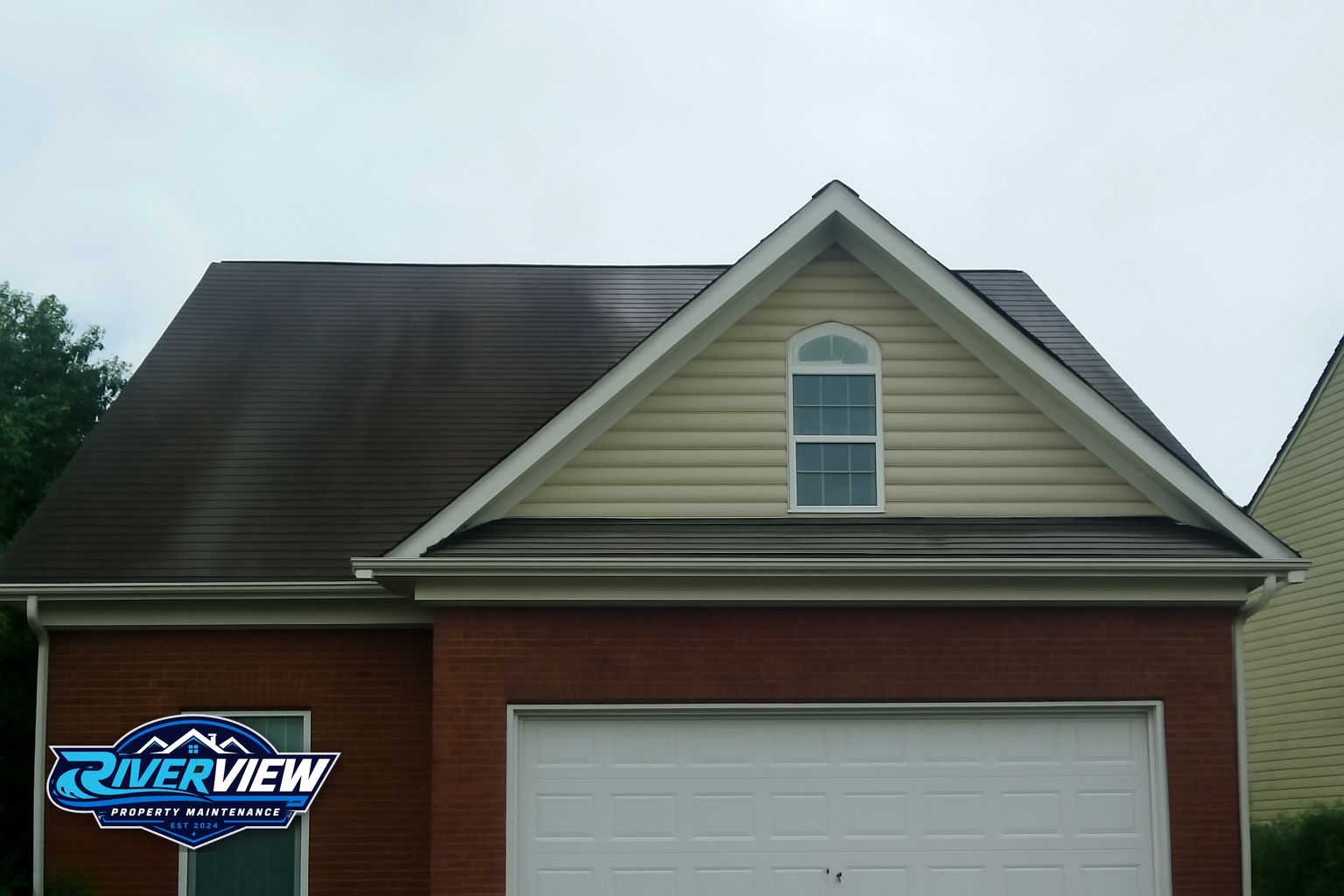
Drive through the neighborhoods off Sugarloaf Parkway or wind through the older streets near downtown Lawrenceville and you'll spot them on almost every other house: long black streaks running down the shingles from ridge to gutter. Most homeowners assume it's plain dirt or maybe a shading issue from nearby trees. It's not. Those streaks are Gloeocapsa magma, a cyanobacteria that thrives in Georgia's humid summers, especially on north-facing roof slopes that stay damp long after the morning dew burns off.
Here in zip codes 30043, 30044, and 30046, we deal with a combination of factors that make algae growth faster and worse than in drier climates. The dense canopy of oaks and hardwoods that make subdivisions like Rivermoore Park and Villages of Towne Lake feel so livable also keep roofs shaded and slow to dry. Add in our famous spring pine pollen coating every horizontal surface and the thick red Georgia clay dust stirred up every time someone grades a new lot nearby, and you've got a roof environment that algae absolutely loves.
Why Pressure Washing Alone Will Damage Your Roof
A lot of folks call us after a neighbor or a handyman told them to just hit the roof with a pressure washer. We understand the impulse, pressure washing works great on driveways and concrete, and we do plenty of that work across Gwinnett County. But shingle manufacturers like GAF, Owens Corning, and CertainTeed all state clearly in their warranty documentation that high-pressure cleaning voids coverage. The granules embedded in asphalt shingles are what protect the underlying mat from UV degradation. Blast them off with a high-pressure nozzle and you've cut years off your roof's life.
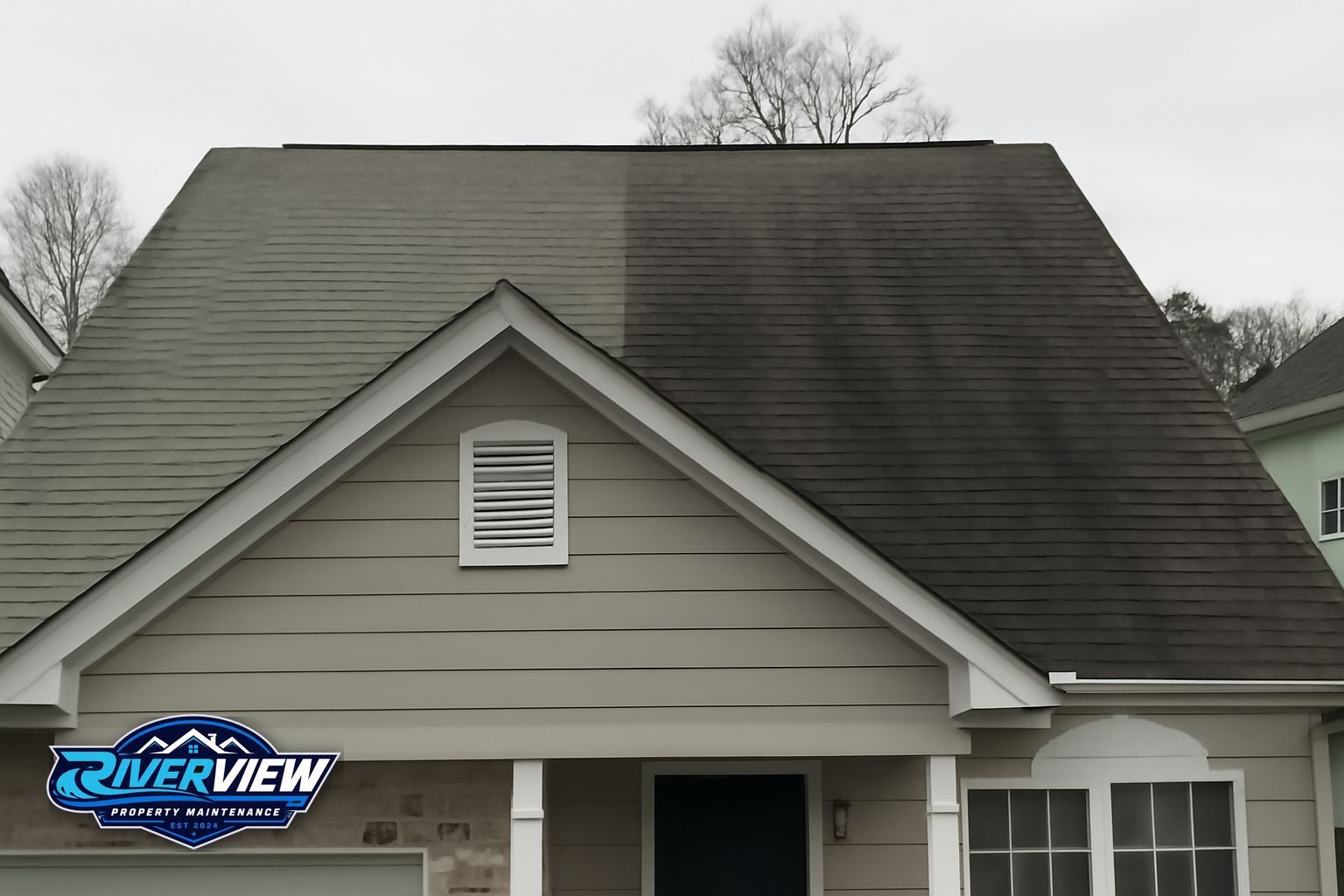
Soft washing is the correct method, and it's the only approach Riverview Property Maintenance uses on roofs. We apply a low-pressure mixture of sodium hypochlorite, a surfactant, and water that kills the algae, mold, mildew, and any moss at the root level. The organisms die, the staining rinses away naturally with rain over the following weeks, and your shingles stay intact. No granule loss. No warranty void. No risk of forcing water under flashing around your chimney or pipe boots.
What the Algae Is Actually Doing to Your Shingles
It's easy to think of the black streaking as cosmetic, just an eyesore that hurts curb appeal and maybe nudges your home's value down when you're ready to sell. That part is true, but the damage goes further. Gloeocapsa magma holds moisture against the shingle surface around the clock. That persistent moisture accelerates granule shedding, creates conditions where moss and lichen can take hold next, and in Georgia winters, even our mild ones, repeated freeze-thaw cycles in that trapped moisture crack the shingle mat from underneath. Left alone for three to five years, what started as a cosmetic issue becomes a legitimate structural one.
Homes in Lawrenceville Most Likely to See Heavy Algae Growth
- Homes in Rivermoore Park and similar mature-tree neighborhoods where canopy keeps roof slopes shaded past midmorning
- North and northwest-facing roof planes on any home in 30044 and 30046 that get minimal direct sun
- Houses near seasonal drainage areas or detention ponds common in Sugarloaf-area developments
- Older homes in the historic neighborhoods around downtown Lawrenceville where oak tree roots and canopy are well established
- Any roof that went more than three years without treatment after the initial algae colony appeared
Our Soft Washing Process for Lawrenceville Roofs
When we arrive at your home, we start by walking the roof line from the ground and from a ladder to assess pitch, shingle condition, the location of any skylights or solar panels, and how close landscaping is to the home's perimeter. Plants and shrubs get pre-wetted and protected before we begin. We use low-pressure equipment, nothing above 100 PSI at the surface, so the solution does the work, not the force of water.
The treatment is applied evenly across all algae-affected areas and left to dwell. Gutters are rinsed clean as part of the process because the runoff carries dead algae and debris with it. We use a neutralizing rinse at the ground level to protect any ornamental beds or turf nearby. Most Lawrenceville residential roofs take two to three hours from setup to cleanup. Results are visible immediately in the loss of green and gray tones; the full clearing of the dark streaks typically finishes over the following four to eight weeks as rain rinses away the dead material.
How Often Should Lawrenceville Homeowners Schedule Roof Soft Washing?
In Georgia's climate, most homeowners in the Lawrenceville area see algae return in two to four years after a soft wash treatment. Homes with heavy shade coverage on the north slopes are closer to the two-year end of that range. Homes with more sun exposure and good airflow might push toward four years. We often recommend pairing roof soft washing with an annual gutter cleaning so we're on-site regularly enough to catch any early algae regrowth before it becomes a full streak situation.
If your HOA in a community like Sugarloaf Country Club or a Rivermoore Park section has issued a notice about roof appearance, a soft wash is almost always the fastest and most cost-effective way to resolve it without any damage to the shingles that could affect a future insurance claim or home sale inspection.
Soft Washing vs. Roof Replacement: Know the Difference
We hear it often from homeowners who got a scare from a roofer's inspection: "They told me I need a new roof because of all the algae." Sometimes that's accurate. Shingles that are curling, cracking, or missing granules down to the mat do need replacement, and no amount of soft washing fixes mechanical damage. But we've also seen plenty of roofs in the 30044 and 30046 zip codes that looked terrible from the street, all dark streaks and discoloration, that turned out to have perfectly sound shingles underneath. A soft wash cleaned them up completely and the homeowner saved tens of thousands of dollars.
We're not roofers and we're not here to tell you a roof is fine when it isn't. What we can tell you is that soft washing is a reasonable first step before committing to a full replacement, and the cost difference is dramatic. If the roof needs to come off regardless, you've spent a few hundred dollars to confirm it. If it didn't need replacement, you've just saved your shingles and your wallet.
Serving Lawrenceville and the Surrounding Gwinnett County Communities
Riverview Property Maintenance is based in this area and works throughout Lawrenceville's zip codes, 30043, 30044, 30045, and 30046, as well as the broader Gwinnett County market including Dacula, Buford, Grayson, Loganville, and Mulberry. We also cover Barrow County communities like Winder, Auburn, and Bethlehem. When you call us, you're talking to someone who actually knows the difference between the soil conditions near Tribble Mill Park and the drainage patterns in the Hamilton Mill area of Dacula. That local knowledge matters when we're planning a roof treatment or protecting your landscaping during a wash.
Frequently Asked Questions
Is roof soft washing safe for all shingle types common in Lawrenceville, GA?
Yes. Low-pressure soft washing is safe for asphalt shingles, architectural shingles, and 3-tab shingles, the types most commonly installed in Lawrenceville and Gwinnett County subdivisions. We do not use high-pressure equipment on roof surfaces, which is what causes granule loss and warranty voids. If you have metal roofing, cedar shake, or tile, let us know when you call so we can adjust the solution mix and rinse method accordingly.
How long does roof soft washing take on a typical Lawrenceville home?
Most single-family homes in the 30043, 30044, and 30046 zip codes take two to three hours from setup through final rinse and cleanup. Larger homes, steeper pitches, or roofs with significant moss in addition to algae may run a bit longer. We'll give you a realistic time estimate when we quote the job.
Will the black streaks disappear immediately after soft washing?
You'll see a visible improvement the same day, especially in green or gray mildew tones. The darker black streaks from Gloeocapsa magma algae typically clear fully over four to eight weeks as rainfall rinses away the dead organism material. This is normal and expected, it is not a sign the treatment didn't work.
My HOA sent a letter about my roof in Rivermoore Park. Will soft washing satisfy their requirements?
In most cases, yes. HOA notices about roof appearance in Lawrenceville communities like Rivermoore Park, Sugarloaf, or similar subdivisions are almost always triggered by algae streaking and discoloration, which soft washing addresses directly. We can provide documentation of the service if your HOA requires it. Call us at (470) 968-5156 and we'll get you taken care of quickly.
Does Riverview treat the landscaping before applying soft wash chemicals to my roof?
Yes, always. Before we begin, we pre-wet any plantings, shrubs, or grass near the home's perimeter and use protective measures where needed. After the treatment, we rinse the ground level with a neutralizing solution. Protecting your landscaping is a standard part of every roof soft washing job we do in Lawrenceville and across Gwinnett County.
How much does roof soft washing cost in Lawrenceville, GA?
Pricing depends on the square footage of the roof, the pitch, and the severity of the algae growth. Most single-family homes in Lawrenceville come in well under the cost of even a partial roof repair. We offer free on-site or remote quotes, just call (470) 968-5156 or reach out through the website and we'll get you a number quickly with no obligation.