If you've driven through Auburn, GA neighborhoods like Alcovy Crossing or the subdivisions off Hwy 29 near the 30011 zip code, you've probably noticed the same thing on a lot of roofs: wide, dark brown-to-black streaks running down the shingles from the ridge. Some roofs also carry a green or gray-green tinge that gets worse every summer. This isn't just dirt. It's a living organism called Gloeocapsa magma, a type of algae that feeds on the limestone filler in asphalt shingles. Left unchecked, it can shorten the life of a 25-year roof by years, raise your cooling costs, and in some cases void your shingle warranty.
Riverview Property Maintenance serves the Auburn and Bethlehem area and the broader Barrow County corridor, and roof soft washing is one of the most requested services we get calls about during late spring and early fall. Auburn's climate is a perfect recipe for algae growth: hot, humid Georgia summers, plenty of mature oak and pine canopy, and north-facing roof sections that stay shaded and damp for hours after a rain. Red Georgia clay dust also settles into roof valleys and along shingle tabs, giving algae and moss an even better foothold.
What Is Roof Soft Washing, And Why Does It Matter?
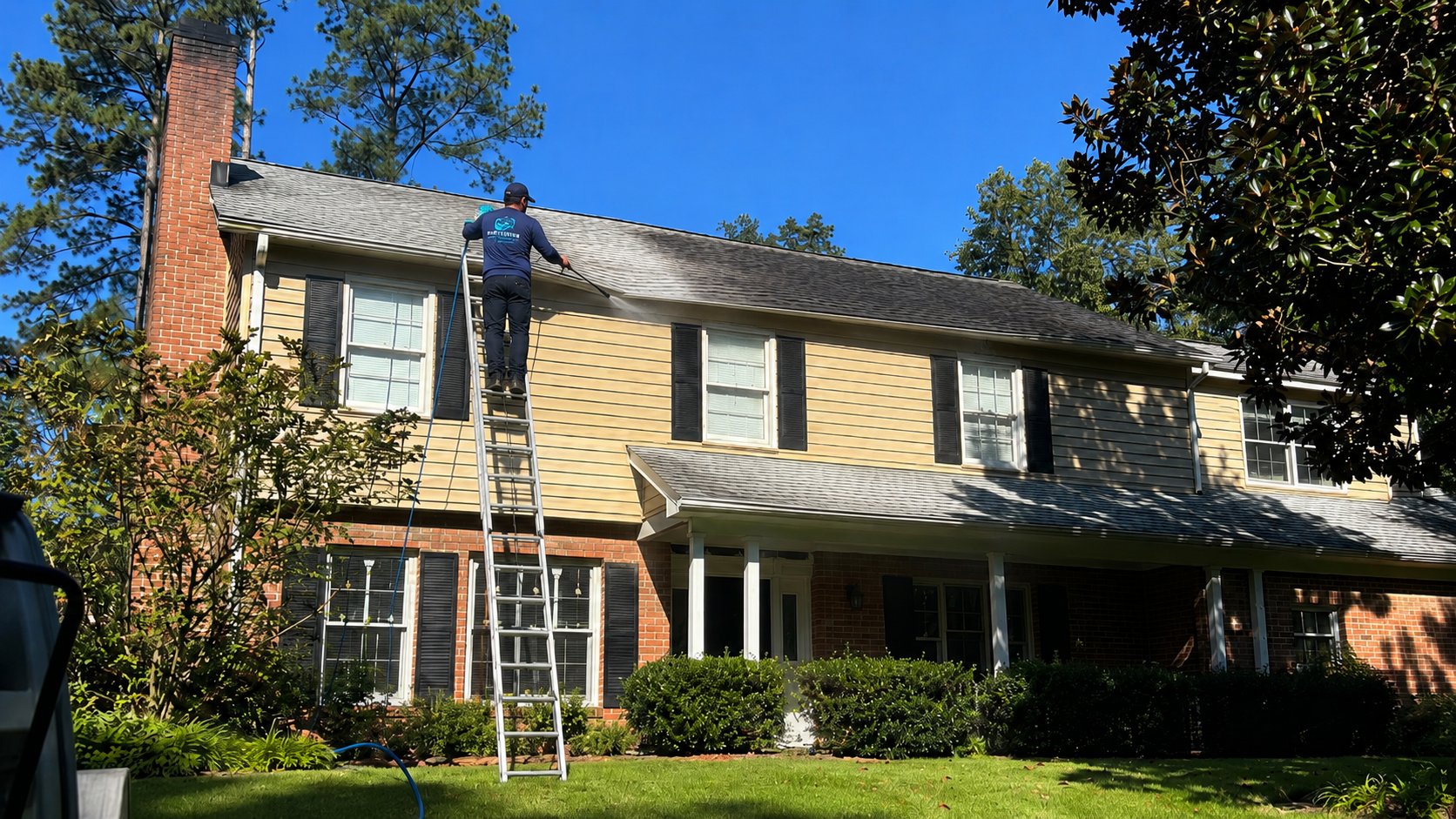
Soft washing is a low-pressure application process that uses an EPA-registered biocidal cleaning solution, typically a diluted sodium hypochlorite blend with a surfactant, applied at pressures well below what a standard pressure washer runs. The solution does the cleaning work; the pressure is just there to rinse. This matters because standard pressure washing can blast off granules from asphalt shingles, break the seal on shingle tabs, and force water up under flashing. Many shingle manufacturers, including Owens Corning and GAF, specifically recommend low-pressure soft washing for algae removal and warn that high-pressure cleaning can void your warranty.
At Riverview, we follow ARMA (Asphalt Roofing Manufacturers Association) guidelines on roof cleaning. That means proper dilution ratios, a dwell time that lets the solution kill the algae at the root rather than just bleach the surface appearance, and a thorough rinse to protect your landscaping and gutters. We also pre-wet and post-rinse any plantings around the perimeter of your home before we start.
Why Auburn Roofs Are Especially Vulnerable
Auburn sits at the western edge of Barrow County, right where Georgia's Piedmont humidity really settles in during summer. A few factors stack up to make roof algae and moss worse here than in many other areas of the metro.
Tree Canopy and Shade
Subdivisions around Auburn and the Hwy 316 corridor into Gwinnett tend to have mature hardwoods and pines. Oak and sweetgum trees drop pollen, debris, and leaf litter that accumulates in valleys and low-slope sections. Shaded sections of the roof dry out much more slowly after summer thunderstorms, creating exactly the moist environment algae and moss prefer.
Pine Pollen Season
Every March and April, pine pollen coats everything in Barrow and Gwinnett County, cars, patios, gutters, and roofs included. That yellow-green layer isn't just a nuisance. It carries organic material that feeds biofilm and algae colonies once humidity picks back up in May and June. By midsummer, the streaks you barely noticed in spring are much more pronounced.
North-Facing Roof Planes
It's almost always the north-facing side of a roof that shows algae first. North slopes get the least direct sun, so moisture lingers. If your home in Auburn sits in a lot with any kind of tree coverage to the south, that effect is compounded. We see this pattern constantly in neighborhoods like those off Alcovy Road and in the areas just inside the 30011 zip code bordering Gwinnett.
What the Roof Soft Washing Process Looks Like
From the time we pull up to the time we're loaded back in the truck, most Auburn residential roofs take two to four hours depending on size, pitch, and how heavy the algae growth is. Here's the general sequence we follow on every job.
- Pre-inspection: We walk the perimeter, look for any damaged shingles, loose flashing, or clogged gutters that need attention before we start.
- Plant and landscape protection: We pre-wet all beds, shrubs, and lawn areas that fall under the drip line of the roof before any solution goes up.
- Gutter check: If gutters are heavily clogged, we recommend clearing them first so rinse water doesn't back up under the fascia. We offer gutter cleaning as an add-on.
- Solution application: Our soft wash mix is applied at low pressure from the eave up toward the ridge, never from the ridge down, which can force water under shingles.
- Dwell time: The solution typically needs 10 to 20 minutes to kill algae, moss, and mildew at the root level rather than just bleaching the visible growth.
- Rinse: We rinse thoroughly at low pressure, working from the ridge down. Runoff is diluted sufficiently that it won't harm established landscaping.
- Post-rinse of plants: Any beds or grass that took runoff get a final fresh-water rinse.
- Final walkthrough: We take photos for our records and walk the job with you before we leave.
How Long Will the Results Last?
After a proper soft wash, most roofs in the Auburn and Barrow County area stay clean for two to four years. The actual timeframe depends on tree coverage, roof pitch, and how quickly pollen and debris re-accumulate. Steeper roofs shed debris faster and tend to stay cleaner longer. Low-slope sections or valleys under heavy shade may show some re-growth a little sooner. Many of our customers in the 30011 area get on a two-year maintenance cycle, which keeps their roof looking clean year-round and prevents algae from re-establishing a deep root in the shingle granules.
Roof Soft Washing vs. Roof Replacement: Know the Difference
One of the most important things we tell homeowners in Auburn is this: algae stains and black streaks are not structural damage. A roof that looks terrible because of Gloeocapsa magma may still have years of serviceable life left in the shingles. Before you take a roofing contractor's word that you need a full replacement, it's worth getting the roof cleaned and then doing a proper inspection. We've seen homeowners spend thousands on a new roof when a two-hundred-dollar soft wash and a clear-eyed inspection would have shown the underlying shingles were fine. Of course, if your shingles are genuinely at end of life, no amount of cleaning changes that. But you deserve to know which situation you're actually in.
Other Services We Offer in Auburn, GA
Roof soft washing is a popular standalone service, but many Auburn homeowners bundle it with other exterior cleaning on the same visit to save on trip costs. While we're already on-site and set up, it's easy to add on house soft washing for your vinyl, brick, or Hardie siding, driveway and concrete cleaning to get rid of red clay staining and mildew, gutter cleaning and flush-out, deck or fence cleaning and brightening, or window cleaning. We serve the full 30011 zip code and make regular runs into the neighboring Gwinnett County areas along the 316 corridor.
Pricing and What to Expect When You Call
Roof soft washing pricing in the Auburn area depends on the square footage of your roof, its pitch, and the level of algae or moss growth. A standard single-story ranch in the 30011 zip code will run less than a two-story home of the same footprint because of access and safety setup time. We give flat, itemized quotes before any work starts, no surprise line items after the job. When you call (470) 968-5156, you'll talk to someone who knows the area, not a call center. We'll ask a few basic questions, often can quote over the phone or through a quick photo, and get you scheduled promptly.
Frequently Asked Questions About Roof Soft Washing in Auburn, GA
Frequently Asked Questions
Is soft washing safe for all types of shingles?
Yes, when done correctly. Soft washing uses very low pressure, typically under 100 PSI at the surface, so it doesn't dislodge granules or break shingle tabs the way high-pressure washing can. It's the method recommended by ARMA and most major shingle manufacturers including Owens Corning and GAF. At Riverview, we follow those manufacturer guidelines on dilution ratios and application technique on every job.
Will the cleaning chemicals hurt my landscaping in Auburn's clay soil?
The sodium hypochlorite solution we use is diluted well below levels that damage established plants, and we always pre-wet and post-rinse any beds, shrubs, and lawn areas around the perimeter before and after the job. The red Georgia clay soil common in the 30011 area drains reasonably well, which helps dilute any incidental runoff further. We've cleaned hundreds of roofs in Barrow and Gwinnett County without landscaping damage when proper pre-wet and rinse steps are followed.
How long will my Auburn roof stay clean after soft washing?
Most roofs in the Auburn and Barrow County area stay visibly clean for two to four years after a full soft wash treatment. Heavy tree canopy and north-facing slopes may show some re-growth sooner. We recommend a two-year maintenance cycle for homes with significant shade coverage, and a three-year cycle for well-exposed roofs. Keeping gutters clean also helps, clogged gutters hold moisture against the fascia and the bottom course of shingles, which accelerates re-growth near the eaves.
Do I need to be home during the roof soft washing appointment?
You don't have to be home, but we do ask that someone is available by phone when we arrive to confirm any access details, and ideally for a quick walkthrough when we finish. If you can't be there at all, just let us know in advance and we'll work out the details. We take before-and-after photos on every job and send them over when we're done.
Can you clean my roof and my driveway on the same visit?
Absolutely. Bundling services is one of the most cost-effective ways to get everything done. Many Auburn homeowners combine roof soft washing with driveway and concrete cleaning, especially since red clay staining on concrete and algae on shingles tend to build up on the same schedule. We can also add house soft washing, gutter cleaning, or deck cleaning to the same visit. Just mention what you're interested in when you call (470) 968-5156 and we'll build out a combined quote.
What's the difference between the black streaks and the green growth I see on my Auburn roof?
The dark brown or black streaks that run vertically down shingles are almost always Gloeocapsa magma, a cyanobacteria (commonly called algae) that feeds on the limestone in your shingles. The green or gray-green patches, often found in valleys or along the eave line, are typically moss or lichen, which are more stubborn because they develop root-like structures called rhizoids that attach to the shingle surface. Both are treated with soft washing, but heavy moss or lichen growth may require a longer dwell time or a follow-up treatment. We'll let you know upfront if that applies to your roof.